


The SME's Step-by-Step Guide to Agentic AI: From Efficiency to Strategic Autonomy
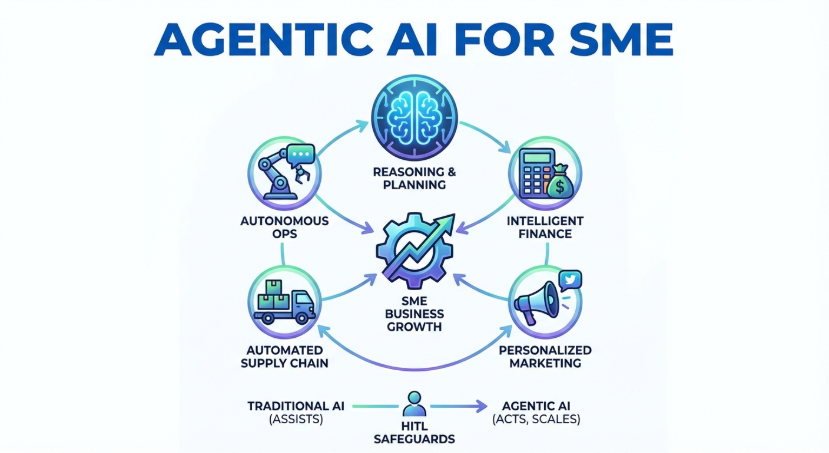
In 2026, the competitive landscape for Small and Medium Enterprises (SMEs) has shifted. It is no longer about who has the largest team, but who has the smartest agents. While traditional AI assists, Agentic AI acts—independently planning, using tools, and executing complex workflows to drive business growth.
For SMEs, this means "doing more with less" is no longer a slogan; it is a technical reality.

1. High-Impact Use Cases for SMEs
Unlike simple chatbots, AI agents can handle multi-step reasoning. Here is where they are delivering the highest ROI for SMEs today:
- Autonomous Customer Operations: Agents that don't just answer FAQs but proactively resolve shipping delays, process refunds, and update CRM records without human intervention.
- Intelligent Financial Treasury: AI agents that monitor cash flow in real-time, automatically moving idle funds into higher-yield accounts or flagging tax-deductible expenses as they happen.
- Hyper-Personalized Marketing at Scale: Agents that monitor social trends, draft localized content, and adjust ad spend across platforms based on hourly performance data.
- Automated Supply Chain Management: From identifying inventory shortages to autonomously contacting suppliers for quotes and drafting purchase orders.
2. The Architecture: How It Works
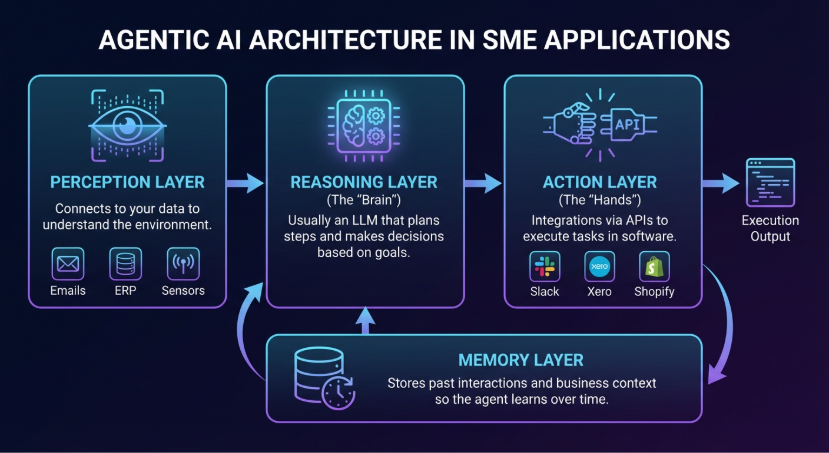
To move from a "prompt-based" model to an "agentic" one, your business needs a structured architecture. At Aiken Digital, we specialize in building the four core layers required for autonomy:
3. The Roadmap to Implementation
A successful rollout doesn't happen overnight. We recommend a phased approach to minimize disruption:
- Phase 1: Diagnostic: Identify high-friction, repetitive tasks. We help you map these to "Agentic" potential.
- Phase 2: Pilot: Deploy a single-purpose agent (e.g., an automated vendor onboarding agent) in a sandboxed environment.
- Phase 3: Integration: Connect the agent to core business systems with human-in-the-loop (HITL) safeguards.
- Phase 4: Scaling (Ongoing): Move from single agents to Multi-Agent Systems where different AI "specialists" collaborate.
4. Cost vs. ROI: The SME Equation
The primary barrier for SMEs is often the perceived cost. However, Agentic AI shifts the economic model from variable labor costs to fixed digital assets.
- Initial Investment: Includes platform setup and API integration.
- Operational Savings: Many SMEs report a 40-60% reduction in manual processing time within the first six months.
- Scalability: Unlike hiring, an AI agent can handle a 10x spike in volume with near-zero marginal cost.
5. Risks and Governance
Autonomy brings risks that require professional oversight:
- Hallucinations in Action: An agent making a wrong decision in a live system. Mitigation: Strict threshold-based approvals (Human-in-the-loop).
- Security & Data Privacy: Unauthorized access to sensitive financial data. Mitigation: Zero-trust architecture and per-agent permission scoping.
- Cost Overruns: Recursive loops that burn API tokens. Mitigation: Monitoring dashboards and hard usage caps.
Future-Proof Your Business with Aiken Digital
The transition to an agentic workforce is the biggest productivity lever available to SMEs this decade. At Aiken Digital, we don't just provide tools; we provide the strategic roadmap and technical expertise to turn AI from a buzzword into a high-performing team member.
Ready to automate your growth?
- Get a custom roadmap: Book a 1-on-1 Strategy Call
Would you like me to tailor this pillar specifically for a certain industry, such as E-commerce, Manufacturing, or Professional Services?


