


The CFO’s Guide to AI ROI: Measuring the Impact of Autonomy
For many Finance Leaders, AI has long been viewed as a "shiny object"—an experimental cost center with vague promises of "efficiency" but little bottom-line clarity. However, the shift from basic automation to Agentic AI has fundamentally changed the financial equation. We are no longer talking about software subscriptions; we are talking about Digital Labor.
If you are evaluating an AI investment, here is how to calculate the true return on investment (ROI).

1. Beyond Hours Saved: Measuring "Opportunity Cost"
Traditional automation (like Zapier) is often measured by "minutes saved per task." While useful, this metric is incomplete. The real value of Agentic AI lies in the Opportunity Cost of Manual Labor.
When your senior sales reps or operations managers are bogged down by unstructured data entry, lead qualification, or manual follow-ups, they aren't just "slow"—they are unavailable for high-value strategic work.
- The Formula: (Hours spent on manual logic × Hourly rate of expert) + (Potential deal value lost during delay).
Agentic AI reduces the "Time-to-Value" by processing leads in seconds, ensuring that your most expensive human assets are only focused on the final 10% of the value chain: closing and strategy.
2. The Digital Labor vs. Human Labor Ratio
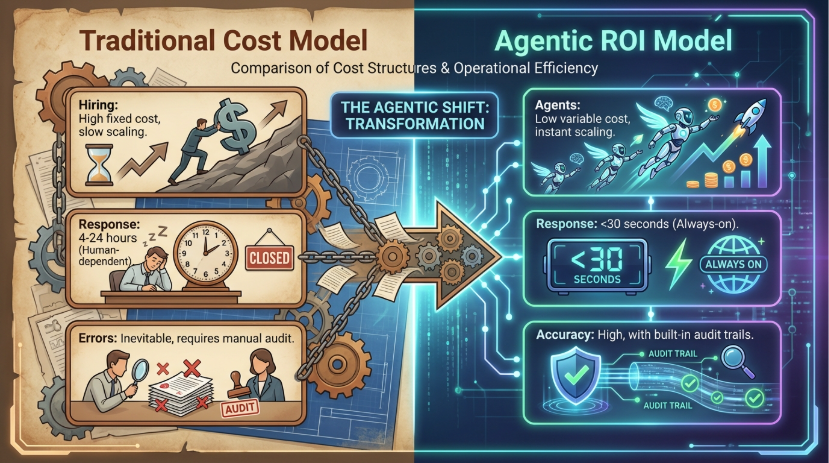
The most significant shift in the CFO’s ledger is the concept of a Scalable Workforce. Hiring a new human employee involves fixed costs: salary, benefits, office space, and a 3-6 month "ramp-up" period.
Digital Labor, however, scales horizontally with zero marginal training cost. Once an AI Agent is trained on your company’s "reasoning logic," it can be duplicated instantly to handle 10x the volume.
- Metric to Watch: Revenue per Employee. By maintaining a lean human team supported by an "Agentic Swarm," SMEs can achieve revenue-per-head ratios typically seen only in top-tier tech giants.
3. Error Rate Reduction and "Rework" Costs
Human error is a hidden tax on every business. A missed follow-up, a typo in a contract, or a misclassified lead costs more than just time—it costs reputation and revenue.
Unlike traditional "If-Then" bots that break when data is messy, Agentic AI uses reasoning to self-correct. By implementing AI agents that cross-reference data across your CRM and ERP systems, businesses typically see a 60-80% reduction in "rework" costs. For a CFO, this translates to more predictable margins and lower operational risk.
4. Direct Impact on Customer Lifetime Value (LTV)
Speed is a competitive moat. In the age of WhatsApp and instant gratification, the first business to respond to a query wins the deal 78% of the time. Agentic AI ensures a "Zero-Latency" response. By increasing the speed and quality of interaction, you aren't just cutting costs; you are increasing the conversion rate and the LTV of every lead generated.
Stop Guessing. Start Calculating.
AI is no longer a line item for the IT department; it is a strategic lever for the Finance department. The question is no longer "What does AI cost?" but "What is the cost of staying manual while your competitors automate?"
Ready to see the hard numbers for your business?


