


Agentic AI vs. Traditional Automation: Why "If-Then" Is No Longer Enough
For the past decade, Small and Medium Enterprises (SMEs) have relied on the "Golden Rule" of productivity: Linear Automation. Tools like Zapier or Integromat (Make) allowed us to connect App A to App B using simple "If-This-Then-That" (IFTTT) logic. It was a revolution—until the world got messy.
In today's fast-paced digital economy, linear logic is breaking. If a customer sends an email that doesn’t fit a specific template, or if a vendor changes their pricing structure unexpectedly, traditional automation simply stops. It hits an error, sends a "Failed" notification, and requires a human to step in.
We are seeing a fundamental shift: The transition from Static Automation to Agentic AI.

The Evolution: Trigger-Based vs. Goal-Based Workflows
Traditional automation is Trigger-Based. It is a train on a track; it can only go where the rails are laid. If there is a pebble on the track (unstructured data or an unexpected variable), the train derails.
Agentic AI, however, is Goal-Based. Instead of following a rigid sequence of steps, you give an Agent a destination and the tools to get there. It doesn’t just "execute"; it reasons.
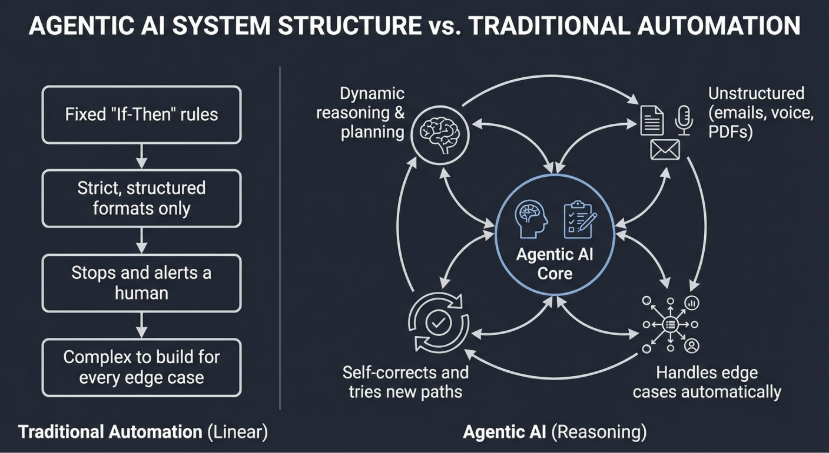
Handling the "Messy" Middle: The Power of Unstructured Data
Consider a typical sales inquiry. A traditional automation might look for a specific "Subject Line" to route a lead. But what happens when a high-value prospect sends a rambling, three-paragraph email that mentions a budget, a technical pain point, and a request for a meeting next Tuesday—all in one go?
- The Traditional Tool: Might extract the email address but miss the urgency and the technical context. It can't "understand" the sentiment.
- The AI Agent: It reads the entire "messy" email, identifies the technical pain point by cross-referencing your product documentation, checks your team’s calendar for Tuesday, and drafts a personalized response that addresses the specific budget concerns.
The Agent treats the unstructured data not as noise, but as a map. It uses Large Language Models (LLMs) to bridge the gap between human chaos and digital systems.
Why "If-Then" Breaks in Business
Business conditions change daily. APIs update, market prices fluctuate, and customer behavior shifts. If your business is built on thousands of "If-Then" rules, you are building a "brittle" infrastructure. Every time something changes, a human developer has to manually update the logic.
Agentic AI creates Resilient Infrastructure. Because the Agent understands the intent of the task (e.g., "Onboard this client as quickly as possible"), it can adapt if a specific software tool is down or if a client provides an incomplete document. It can ask follow-up questions or find an alternative route to the goal.
The Competitive Edge: From Doers to Orchestrators
By moving to Agentic AI, your team stops being "troubleshooters" for broken automations. Instead, they become AI Orchestrators. They define the goals, set the guardrails, and let the Agents handle the execution. This allows SMEs to operate with the efficiency of a much larger corporation without the massive headcount.
The era of the rigid flowchart is ending. The era of the reasoning agent is here.
Upgrade Your Intelligence with Aiken Digital
Is your business still running on brittle, linear tracks? Don’t let "If-Then" logic hold back your growth. Transform your workflows from static to strategic with us.


